Wednesday, August 31, 2011

Reuniting History

Who doesn’t love a reunion?

It’s a time when friends who may not have seen each other for many years reminisce, exchange personal stories, and catch up on everything new in their lives. Photos are generally taken, endless questions asked, and hugs and handshakes exchanged. I look forward to reunions for months, even years in advance, especially since they only come around every five or ten years. But the reunions I am talking about are not family reunions or the reuniting of my high school class, even though I do enjoy them. I am referring to the championship team reunion celebrations that take place across each state, every year, celebrating a basketball accomplishment that may have taken place decades ago. Although every celebration is important in its own right, I have tried to attend the reunions of those teams that have left a large imprint in high school basketball history. 

My family traveled to Muncie, Ind. for our first reunion celebration in February 2004.  Muncie Central High School has fielded a boys basketball team for over 100 years, and is Indiana's winningest program with the most state championships (8 State Titles, 7 runner-ups), but our 850 mile round trip was to meet the team that beat them in the 1954 state championship game – the Milan Indians. All basketball fans are familiar with the Milan story. A town, with a population of 1,150, and a school of 161 students — 73 boys, win the one-class Indiana state championship against powerhouse Muncie Central (enrollment 1,662), on a last-second shot by Bobby Plump. Milan is arguably the most famous small town in high school sports history. More than 40,000 people came to Milan the next day to congratulate and celebrate with them.


After traveling throughout the night, we made our way to the reunion celebration at a local Muncie hotel.  We chatted with the 1954 Milan team, including Ray Craft, Gene White, Bobby Plump, Glenn Butte, Bob Engel, Rollin Cutter, and Roger Schroder.  We talked to the 1954 Milan players about their 28-2 season, the championship game, playing ball together growing up in Pierceville Ind., coach Marvin Wood, playing against Oscar Robinson, one-class basketball, and the list goes on and on.  
 
Milan's Bobby Plump
Even though we were tired, we stayed to watch the present day Milan and Muncie Central varsity teams play each other in Muncie Central’s historic Fieldhouse.  The game was even broadcasted live on ESPN Classic and a special ceremony took place at halftime to honor both the 1954 Milan Indians and Muncie Central teams. This was the first time we witnessed Hoosier Hysteria and it was unforgettable. The crowd of 6,500 was loud throughout the game, even when Muncie Central took a commanding lead in the second half.  The spectators near us were amazed that we would drive from Missouri to celebrate the occasion.  We told them the game may have taken place in Indiana, but the story belongs to basketball coaches, players, and fans across the country.  The Milan team continues to reunite each year for various events, meeting fans and telling the story of how they were able to slay Goliath.
 
The next reunion we attended was in 2006 to celebrate the 20th anniversary of the making of the sports movie, Hoosiers. Released in 1986, the film was inspired by Milan's 1953-54 championship season. As everyone knows, the film is about a small-town Indiana high school basketball team, the Hickory Huskers, that overcome adversity to win the 1952 state championship.

Huskers team photo, which still hangs in the gym today
We were excited to hear that the movie's writer, Angelo Pizzo, and four members of the Hickory Huskers team would attend the reunion in Knightstown, Ind, in the gym made famous by the movie. We arrived early to The Hoosier Gym and were able to spend some time talking to the fictional Huskers - Steve Hollar (Rade), Brad Long (Buddy), Wade Schenck (Ollie), and Maris Valainis (Jimmy Chitwood) -  as well as, a few of the local supporting cast members.

A few of the Hickory teammates had not seen each other in years and in almost all cases, they had not been back to The Hoosier Gym since the filming. When Robert Swan (Rollin - assist. coach) walked in and approached the grown players, you immediately knew that he had not seen them since 1985. And you immediately knew that they had a great working relationship while filming the movie, because many hugs and stories  were exchanged.  We talked to them about everything from the making of the movie, its impact on them personally, the passing of Kent Poole, to playing high school basketball in Indiana, since all members of the Huskers were local high school players. 

Jaryt and I with the Hickory Huskers in 2006
We asked Steve and Brad if they get tired of the recognition or talking about the film and they quickly responded that they do not.  They also said they don't mind being called their character's name when out in the communities.  Although they did not realize that the movie would become what it is today, they were honored to be apart of it.

The Hoosier Gym
Although some of the Hickory Husker players were successful in their own right during their high school playing days, they will always be remembered for their inspirational roles in Hoosiers.  And The Hoosier Gym will always be taken care of by the community, so visitors traveling through Indiana on Interstate 70, can stop in to shoot a few baskets, look at the movie memorabilia, tour the locker rooms, and walk through the gym doors and say "Welcome to Indiana basketball".

I enjoyed the reunion so much that in July 2010, I went back again for the 25th anniversary reunion, making it seven times that I have traveled to Knightstown and visited The Hoosier Gym. The Hoosier Gym actually holds the reunion each June, although the movie's cast comes back every 5-10 years.

Meeting with Maris at the 25th anniversary reunion
Maris and Angelo catching-up
If you want to experience Hoosier Hysteria at its finest, make the trip to Knightstown in June and watch the Hoosier Reunion ALL-STAR Classic Basketball Game. The game showcases the top Indiana high school players in a competitive game, where the teams play for either Hickory or Terhune.  If you stay the weekend, you will enjoy an evening sock hop and 50’s diner-style dinner, a golf-outing, as well as, the opportunity to watch the movie Hoosiers in the famous gym.

We attended the 2009 Hoosier Reunion ALL-STAR Classic Basketball Game
My most recent reunion trip was in Illinois. I was thrilled to learn that Collinsville would be organizing a 50th reunion celebration in January 2011 for the 1961 Collinsville Kahoks state and national championship team. I wanted to make this trip for several reasons. I wanted to tour the gym named after legendary coach, Vergil Fletcher, as well as, meet the team who some include in the "greatest Illinois high school team" conversation.  I also wanted to meet Fred Riddle and Bogie Redmon, who were All-State and All-American players who would go on to play ball at Iowa and Illinois.


Riddle, Redmon, Ron Matikitis, Nathaniel Bykit and Joe Brennan of the 1960-61 team - which finished undefeated 32-0 - along with a few cheerleaders and Violet Fletcher, widow of coach Vergil Fletcher all gathered to celebrate as the group.  All were honored before Collinsville's game with Triad.
Introduction of the 1961 Kahok championship team
Presentation of the new Collinsville Kahok team photo
Both Riddle and Redmon were given the microphone during the celebration. Riddle told the crowd that there was only one person who made this special and that was coach Vergil Fletcher.  Redmon mentioned that the state title was the pinnacle of his athletic career.  At Illinois, he beat Kentucky and UCLA, but the highlight was the 1961 state tournament. The Collinsville fans reacted to these comments with loud cheers. 
Talking with Fred Riddle (left) and Bogie Redmon (right)
You might ask what our next reunion celebration trip will be?  We were excited to learn that on Sunday, March 11, 2012 (tentative date) at 11:30am, Hebron, Ill will hold a 60th anniversary celebration of the beloved 1952 Hebron Green Giant state championship team.  If you are from Illinois and a basketball fan, you know the Hebron story.  Alden-Hebron High School is the smallest to win the Illinois boys' basketball championship.  In 1952, the school had just 98 students in attendance when they won the coveted single class state title with an overtime victory over Quincy. Go to the “Hebron Green Giants of 1952” Facebook page to learn more about the reunion celebration.

1952 Hebron Green Giants
What makes these team reunions memorable is not only the time spent hearing everyone's stories or asking the team questions, but the fact that you get to see them interact with their teammates, coaches, community and fans. It takes them back to the days of young, when playing the game was fun. When winning at the high school level was special because they were playing alongside teammates who they had grown up with.  In many ways, these teammates are as close as brothers. They enjoy living the dream once again together, with the people closest to them, even though it is only for a few days. After attending a few of these reunion celebrations, I have came to the conclusion that they are much more special than a reuniting to celebrate an important accomplishment. I guess you can say that the gatherings are a family reunion.  Because that is what good high school teams are...FAMILY.  

Sunday, July 24, 2011

'State Champion' has a nice ring to it


No matter the level, all basketball players dream of winning a championship.  They dream of hoisting the trophy over their heads, cutting down the nets, and most importantly, putting their team and name in the history books forever.  To say that you were the best team, comes with a lot of prestige and pride.  And with the state championship win, also comes a small, sometimes big, token of their hard work, dedication and achievement……a championship ring. 
 
Milan, Ind 1954 championship ring
I am part of the 99.9% of the sports population not lucky enough to have earned one but I have friends who played on state championship teams who have received rings for their achievement.  Two things I can tell you about the rings. They are usually noticeable, due to its size, and the ring is a very good conversation starter.  You take one look at it and you know that this person must have accomplished something great to wear such a large ring.  Within months, those associated with the team begin sporting their rings.  I could only imagine the pride one must have, showing it off to friends, family, or the many others that want to look at it.

1952 Hebron state champions
What if I were to tell you that one of the most recognizable and storied IHSA state championship teams just received their rings in 2004?  After touring Alden-Hebron’s old gym, we also had the pleasure to meet with Phil Judson, of the beloved 1952 Hebron Green Giants state championship team.  We talked about everything related to playing basketball growing up, being a twin (as Jaryt and I are), coaching, to playing for Alden-Hebron and the University of Illinois, to life after basketball.  Jaryt and I had read the “Once There Were Giants” book years ago, so we were familiar with their story, so many questions rolled off our tongues that evening.  But it was during one point of our conversation that we noticed the ring on his finger.  When asked about it, Phil pulled off the 1952 Hebron state championship ring and told us how just a handful of years ago, members of the 1951-52 team decided to order the rings that they never had.

Phil Judson talking basketball with us
He told us he was reading the Chicago Tribune one day, when he noticed a Jostens advertisement, marketing their service of creating custom rings to celebrate personal accomplishments.  Phil mentioned that back in 1952, buying or wearing a championship ring was something that the team never thought about. 

The ad had a direct response number, which Phil decided to call.  He mentioned that he was from Hebron and wanted to order championship rings.  The Jostens representative was familiar with the Hebron story so he informed Phil that a rep would be in the area in the near future.  Phil, Ken Spooner, and Bill Schulz met with the Jostens sales representative in May, 2004 and he helped them capture their story within the design of their ring.  A few months later in August, they were presented with their championship rings and since then, they have displayed and worn them proudly.  The rings that Phil, Ken and Bill wear are exactly alike but Paul Judson’s is slightly different.  Since he spends time in Florida, he was not at the initial meeting, so when he spoke to the Jostens rep at a later date, he ordered a slightly different design.  His ring has a ”#1” on it, rather than a “H” for Hebron.  For those that cannot tell the Judson twins apart, I guess all you have to do is look at their rings.

Phil Judson's ring: 35-1 record
"H" for Hebron

Judson's #9 inscribed in the basketball and dated 1952
Although not every state title team may have them,  I was amazed to learn that probably the most celebrated championship team in state history did not have a ring.  I had seen a 1954 Milan, Ind. championship ring at the Indiana Basketball Hall of Fame in New Castle, Ind., so I assumed that teams wore them in that era.  As we drove to the hotel after spending the evening playing and talking basketball in Hebron, we talked briefly about Phil’s championship ring and why it was not important for them to have rings for so long.  If you have ever spoke to any of the players, they were excited to win the title, but they did not know how important and meaningful their victory had on the state.  A ring was not what they played for. They enjoyed playing the game with their friends, for their coach, their community, and to be the best by beating the best. They never thought the win would have such a profound impact.  Nor did they imagine that people across the country would associate Hebron, with their title team.

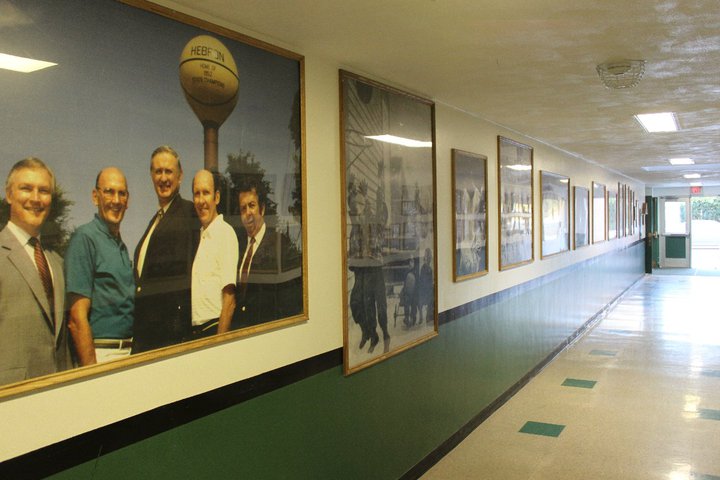
Tribute photos line the hallway outside the gym
We came to the conclusion that for so many years, this team didn’t need a ring to identify themselves.  Their photos and stories were plastered in various newspapers and magazines across the state. Even now, images of their team and their winning season can be found on websites, in books, and even blogs.  Over the last six decades, anytime a conversation led to someone asking them where they are from, they would simply reply, “Hebron, Illinois” and that alone would kick start the conversation and questions about the memorable 1951-52 season.  They are one of the few championship teams that don’t need a ring to identify what they won or who they are. 

The popular Hebron water tower


Thursday, June 30, 2011

The Beginning of the Madness

There are a dozen small town clichés that can describe the village of Manito, Ill, in northern Mason County, near Pekin, Ill.  I have driven through it numerous times when I make my treks back to Missouri or when attending my wife's family gatherings held in the town, so I can contest that you can blink and miss it. 

Established in 1858, the town still showcases its 1858 "Old School" and 1906 "Old Jail".  The three day Manito Popcorn Festival is celebrated annually on Labor Day Weekend, since 1972. It attracts not only local residents, but residents from Mason, Tazwell and Peoria counties as well.  The village of nearly 1,600 is also home to Midwest Central High School and its Raiders, which have played host to the IHSA sectional playoffs.  But what most Illinois high school basketball fans might not realize is the tie the town has to one of Illinois' most coveted basketball traditions.

Small Illinois community
When planning our basketball trips, it is customary to give it a basketball name that is popular within the state we are traveling.  The days leading up to our Illinois trip this past October, it was a no-brainer to identify our trip with the most popular basketball term that originated in Iliinois, "March Madness".  While researching it, I was surprised to learn that Manito was the birthplace of Henry Van Arsdale Porter (H. V. Porter), who would coin the popular phrase in an essay written in 1939.  "March Madness" defined the excitement and spirit of the Illinois high school basketball tournament.  

 H.V. Porter (1891-1975)
Porter was born in Manito on October 2, 1891, but he grew up on a farm near Washington,  Ill.  Following high school he attended Illinois State Normal University and after graduating, he began his career teaching in Mount Zion, Keithsburg, and Delavan.  From 1919 to 1928 he served as principal of Athens High School, where he also coached basketball, leading his team to a second place state finish in 1924.

In 1928, Porter was hired as assistant manager of the Illinois High School Association (IHSA).  Along with organizing a department to license and train officials in sports, such as, football, basketball, and baseball, Porter served as editor of a new monthly magazine, the Illinois High School Athlete.

According to Basketball.org, nearly every magazine contained an article or essay from Porter himself. In 1939, near the end of Porter's tenure at the IHSA, he wrote an essay titled, March Madness, about the fans of the Illinois high school basketball tournament, which during the 1930s had grown in popularity.  The term itself is thought to have come from the old English saying, ‘Mad as a March Hare.’ The essay’s punctual line was,
“When the March madness is on him, midnight jaunts of a hundred miles on successive nights make him even more alert the next day.”

The spirit of March Madness
Shortly thereafter, Porter left the IHSA to become the executive secretary of the National Federation of State High School Associations (NFHS). In 1942 he provided one last contribution to the IHSA’s magazine, a poem titled “Basketball Ides of March“, which ends with the final stanza:
           WIth war nerves tense, the final defense
           Is the courage, strength and will
           In a million lives where freedom thrives
          And liberty lingers still
          Now eagles fly and heroes die
          Beneath some foreign arch
          Let their sons tread where hate is dead
          In a happy Madness of March


Shortly after joining the NFHS , Porter became a member of several influential committees. As a member of the National Basketball Committee, Porter contributed to many innovations that shaped basketball for years to come.

It is also worth noting that Porter was inducted into the Naismith Memorial Basketball Hall of Fame in 1960, in the second inducted class.  The following are his basketball contributions listed on the Hall of Fame website:

"Equipment inventor, rule maker, high-school coach, and athletic administrator, Henry Porter's innovations were vital to the evolution of basketball. In 1933, Porter designed the popular fan-shaped backboard, adopted for official use in 1940-41. In 1935, he pushed for replacement of the then-used cumbersome, irregular, and expensive 32-inch sewn leather ball with a 29 1/2-inch molded leather basketball. Under his leadership, high schools adopted the new ball in 1938, and later in the 1940s, adopted an even better composite-molded basketball. Throughout the 1930s, Porter teamed with Hall of Famer Oswald Tower to create new and consistent rules for basketball. In 1936, Porter published the first high school rulebook standardizing the game across the nation. In 1940, Porter became the first full-time executive secretary and editor of publications at the National Federation of State High School Athletic Association (NFSHSAA), a position he held until 1958."

Career Highlights
  • Served as the first rep for high schools on the National Basketball Rules Committee
  • Pioneered use of motion pictures to study proper playing techniques
  • Published the first high school rule book, 1936
  • Published the first magazine-style state high school association publication, The Illinois Athlete
You can see why I was taken aback to learn that a man of large influence to basketball, state-wide and nationally, came from this small, rural community.  I guess it shouldn’t surprise me when I look at the history of Illinois high school basketball and the list of small town players, coaches, administrators, and programs that have contributed to the game and to the Madness of March.  Trust me when I say that small town clichés do not apply to Porter.  Because when you are reading about Porter and you blink, you can't miss reading his accomplishments and contributions.


Monday, June 6, 2011

Legeman's Court Vision

When entering through the doors to your school’s gymnasium, grabbing a game program and taking a seat in your favorite spot, you generally don’t ask yourself, “who built this gym?” or “why was the gym designed this way?”  If you have been in more than a handful of the tri-state area gyms, you will probably agree that they have their similarities and differences.  But there is one style of gym that is so unique, its design belongs to only a small fraternity of gyms in Illinois, Indiana and Michigan and to one man, whose late night vision would change the basketball landscape for decades to come.  
  
Ralph E. Legeman
Architect Ralph E. Legeman, of Evansville, IN, launched a career in architecture in 1922, designing general buildings but his legacy would be cemented nearly 25 years later with a simple solution to a large problem.  In 1946, he began to be approached by school officials asking him to build them a gymnasium that could hold large capacity crowds, but at a low construction cost, since the cost of labor and materials had increased tremendously in recent years.  With this problem on his mind, Legeman had troubles sleeping. One night with numbers, facts, and figures running through his head, he got out of his bed and went to his desk to do some sketches.  It was that night that his vision of a unique design would become the answer to the school officials problem. Shortly thereafter in 1948, Legeman would file to patent (granted in 1956) his solution, which is to build underground. 

Diagram from the patent
Legeman felt that his underground “bowl” design would be economical in construction, safe and convenient in use and attractive in appearance.  In Legeman’s design, only the roof and upper walls stand above ground. The design also eliminated the need for elaborate structural supports for seating and roofing, which were expensive and constrained by limits in technology.  Bleachers were concrete, built directly on the sloping dirt sides of the excavation and the top of the gym is supported by steel trusses. Spectators are seated up to where the trusses join the abutments. There are no steel rafters above the court, since the abutments support the weight of the structure.

In addition, the underground design would allow the spectators to enter the seats from above and leave the same route, without interfering with persons on the playing floor and without obstructing the views of the persons in the seats.  Also, Legeman thought exits could be installed behind the seats at ground level so that the spectators may leave at many access points and the seats may be quickly emptied at the end of a game.  

Legeman's design became so successful that he would eventually design 27 bowl gymnasiums for both high school and college and license 10 others during the late 1940’s, 50’s, and 60’s.  There were three different gym sizes that a school could build: small, medium, and large.   In 1949, Herrin, IL (Memorial Gym) became the first of 27 bowl gyms and Loogootee, IN would be the last, built in 1968.  Many of Legeman's gyms are noteworthy, large and small, such as Duster Thomas gym in Pinckneyville, IL, the Jacksonville Bowl in Jacksonville, IL and the 12,500 seat multi-purpose arena, Roberts Municipal Stadium, in Evansville, IN.  The most recognized would probably be Chrysler Fieldhouse in New Castle, IN. Chrysler is better known as “The largest high school basketball gymnasium in the world”, since its seating capacity is 9,325, but has held more than 10,000. 

Duster Thomas Gym in Pinckneyville, IL

Chrysler Fieldhouse in New Castle, IN

For someone like myself who grew up in northeast Missouri, I too do not have to travel very far to see or play in a Legeman Gym.  Twenty miles to the east, in Hamilton, IL, Legeman erected their high school gymnasium in 1956.  Once home to the Hamilton Cardinals basketball teams, it is still in use today for a handful of the West Hancock Titan varsity basketball teams home games.  Having traveled to some of Illinois and Indiana’s most decorated basketball schools and gyms, I was excited to learn of the local connection between Hamilton’s gym and the many prominent gyms that Legeman built. 

Hamilton gymnasium interior

Hamilton gymnasium exterior - steel abutments
I am never surprised anymore when I learn something new about the historical relevance of a gym, school or person located down the street or in the area where I grew up.  When recently talking to Hamilton High School Athletic Director, Dave Dion, he mentioned that he too is learning things about his gym after being at Hamilton for 35 years. Uncovering history can start by asking a simple question or by keeping your eyes and ears open to conversations. Basketball history is everywhere around us.  You could even be sitting on it and you might not know it. 


Additional information:
According to chopperinu of IllinoisHighSchoolSports.com, Ralph Legeman Associates, Evansville, Ind.,  designed or licensed bowls in the following cities:
Three gyms yet to be identified, plus:

Norris City
Herrin
Owensville (IN)
Herrin JHS
Murphysboro (now MS)
Huntingburg (IN)
Pinckneyville
Bushnell-Prairie City
Lynnville (IN)
Central (Clifton)
Hamilton
Ridgway
Trico
Jacksonville
Center Grove (IN)
Roberts Municipal Stadium (IN)
Evansville North (IN)
Carmel (IN)
Edinburg (IN)
Boonville (IN)
Connersville (IN)
New Castle (IN)
Indiana Central College (IN) (now UIndy)
L.C. Walker Sports Arena (MI)

Designed by Weber & Curry, Terre Haute, Ind., under license:

Switz City (IN) (now White River Valley)
Clay City (IN)
Orleans (IN)
West Vigo (IN)
Springs Valley (IN)

Designed by James Associates, Indianapolis, Ind., under license:

Brownstown Central (IN)
West Washington (IN)
Eastern (Pekin) (IN)
Indian Creek (IN)

Designed by Lester Routt & Associates, Vincennes, Ind., under license:
Loogootee (IN)

Tuesday, May 24, 2011

A Thirst For Winning

With the Chicago Bulls back in the national spotlight and the emergence of young Derrick Rose as one of the league’s most dominant players, Bulls fans are taken back to the days when another young player was beginning to take flight.  Michael Jordan's emergence would not only change the identity of Chicago and the game... but would also make him one of the most marketed sports figures in history. He was a winner, not only for his city, team and league, but also for any company lucky enough to have him endorse their product.

It was after winning his first National Basketball Association Championship in 1991, that Michael Jordan would begin a long relationship with Gatorade, which would commence with a commercial that would become part of pop culture and lift up two brands to unimaginable recognition and gain. The story of how Michael Jordan came to endorse Gatorade is legendary among marketers but the more captivating story is the origin of the lyrics and song that made the Gatorade commercial popular and made every kid want to Be Like Mike.

Jordan's 1st NBA Championship - 1991
It was 20 years ago when Jordan signed a lucrutive 10-year contract with Quaker Oats, to become Gatorade's exclusive spokesperson, rather than resigning with Coca-Cola.  After the contract was signed, the advertising firm of Quaker Oats made the decision to bring back its creative chief, Bernie Pitzel, to introduce Jordan and Gatorade to the world, as he was told.  One of the challenges that Pitzel soon learned was that prior to his arrival, a commercial had already been approved by Quaker Oats executives, which left him scratching his head since it was the same type of Jordan highlight reel commercial that other endorsers were using to sell their products.  To Pitzel’s dismay, Quaker Oats gave him only 3 days to come up with a new concept.  Upon returning home that evening, Pitzel sat down to watch Disney’s The Jungle Book with his son. When he heard the song "I Wan'na Be Like You," he immediately thought of a creative concept since he knew that a million people wanted to be like Michael Jordan due to his growing popularity.   

Originally, it was Pitzel's plan to use The Jungle Book music over the video, but he soon found out that Disney officials wanted $350,000 from Gatorade for a five-week commercial run in order to use the track.  As a result, he decided that he would write his own lyrics that would play off the concept that everyone wanting to be Jordan. Pitzel then went to his favorite Chicago restaurant, Avanzare, to do some creative thinking.  He soon started writing the following lyrics on the paper tablecloth: 


Sometimes I dream
That he is me
You've got to see that's how I dream to be
I dream I move, I dream I groove
Like Mike
If I could Be Like Mike
Again I try
Just need to fly
For just one day if I could
Be that way
I dream I move, I dream I groove
Like Mike
If I could Be Like Mike


Several hours later, he faxed a ripped tablecloth with the lyrics to four different local music companies, hopeful that one of them would orchestrate a tune that would fit well with his lyrics, since he only had 48 hours left.  One local pair of jingle writers took 'Be Like Mike' and really made it the chorus.  They then hired eight singers to sing the work, rather than one, which sold the concept that everyone wanted to be like Mike.  When finished, they knew that no other company would beat their catchy tune and Pitzel agreed.

Pitzel then drove up to Wisconsin to meet with Gatorade executives and to present the "Be Like Mike" lyrics and tune from a tape played on a boom box. Gatorade executives knew they had a winner. Pitzel then dreamed up the commercial's visual concept, which included a group of children trying to be like Mike in front of Jordan himself at a basketball court in Chicago.  Additional footage was filmed of Jordan playing a pick-up game with grown-ups, goofing around and drinking Gatorade.  These concepts tried to humanize Jordan since most thought of him as a basketball God.  And although we may not be able to fly through the air or play basketball like Michael, we can be like him and drink Gatorade.

Scene from the "Be Like Mike" Commercial

The commercial ended with the simple phrase "Be Like Mike. Drink Gatorade" and that is exactly what happened when it aired in August, 1991. It was a defining moment in Gatorade's history, lifting an already popular product to even greater heights.  It was a winner.

Jordan would go on to appear in over 20 Gatorade commericals, but "Be Like Mike" was the trend-setter because even today, you still hear kids and adults, singing the lyrics to "Be Like Mike".  In 2003, Darren Rovell, who covers sports business for ESPN.com, wrote an article regarding Jordan's best commercials.  All of Jordan's commercials, covering all of his endorsed products, were considered and it wasn't a surprise that "Be Like Mike" was rated #1 because of its popular tagline and catchy tune.  I emailed Bernie Pitzel prior to our trip about the commercial and he replied, “That spot struck quite a chord…anything you can do to effect or become part of pop culture is a huge win.  Be Like Mike did just that.”  

So it was during the Chicago leg of our Illinois basketball trip, that we wanted to pay homage to Michael Jordan in some way, because he was such an influence to us growing up. Most basketball fans, when visiting Chicago,  gravitate to two locations to pay tribute to the greatest basketball player ever.  Most travel to the city’s west side and pose for pictures in front of the famous Jordan statue outside the United Center, while others drive to the Architectural Estates in the north suburbs of Highland Park to take a photo outside Jordan’s front gates (like we did).  But it was another location, a hidden gem of sorts, that we decided to locate to pay homage to not only Michael Jordan but to one of the backdrops for one of the greatest commercials.  

Front gates of Jordan's estate
We wound through various roads into the heart of the Highland Park suburb, until we came to Sunset Woods Park.  Thanks to the Park District of Highland Park, we were able to locate the outdoor basketball courts where Michael Jordan was filmed playing basketball with the kids trying to imitate him, with their between-the-leg dribbling and acrobatic shots.  The court has been replaced in recent years with a skate park but another court sets beside it.  So for an hour, we looked around the area, trying to imagine what it would have been like not only to work with Jordan on the set but also getting the chance, as a kid, to play basketball with him.  Prior to leaving, we played our traditional 2-on-2 game, as we do at all the gyms we visit.  And for a few shots, without trying to injure ourselves, we too tried to "Be Like Mike".


Skatepark (background) where the commercial was filmed
 
Sunset Woods Park


Sunday, May 15, 2011

Centralia’s Masterpiece


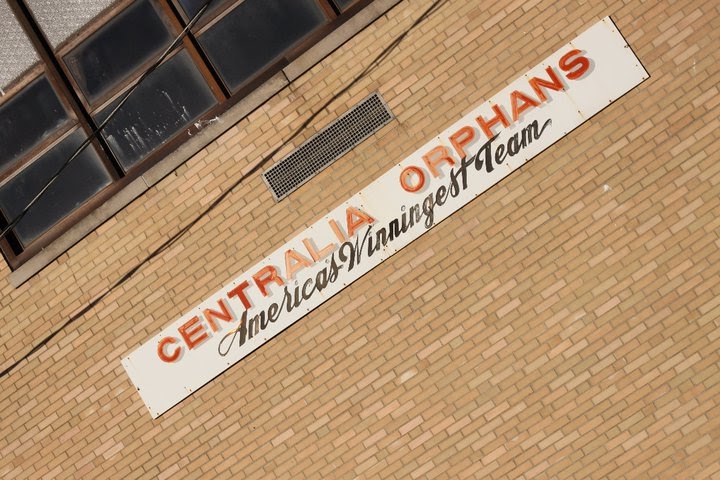
Many basketball enthusiasts say that a trip to Centralia, IL is a basketball pilgrimage because for nearly a century, its Orphans were considered America’s winningest high school basketball team.  Although they have surrendered that title in recent years, you are still reminded of the honor while driving through town.  It was during the 2007-08 season that the Centralia Orphans won their 2,000th game, a feat that only a select few basketball programs can put on their program’s resume.  As you enter the new CHS athletic arena, you are welcomed to the “Home of the Orphans” and to one of the largest high school trophy cases that I have seen.  Trophies, jerseys, and other basketball memorabilia introduce visitors to the teams decorated past but it also reminds its players, students, and community what’s expected in the future. 

One of many trophy cases outside new CHS athletic arena

Even though the program's basketball history is on display at the new school, all basketball enthusiasts will agree that you must take the 2 minute car ride up the road to Trout Gym because it’s the true mecca of Illinois high school basketball.  And until you visit it, your pilgrimage is not complete.

Sign hanging outside Trout Gym
Our family was thrilled to be given the luxury last year to enter Trout Gym, because in 2006 a new school and gym were built and as a result, the old school was sold to a local group, the doors were locked, and the lights were turned out in Trout Gym.  Although a story on Trout Gym is deserving for obvious reasons, it was a hidden gem that caught our eye before we entered the historic gym, that I had to write about.  Above the gym’s entrance, a colorful stained glass work of art is arranged to depict a Centralia player in motion, shooting the ball over his opponent.  But, it’s the message incorporated into the stained glass that left an everlasting impression with us. 

Stained glass window from the outside

In 1936, Trout Gym was built in the midst of the Depression as a project of the Federal Emergency Administration of Public Works, which concentrated on the construction of large-scale public works such as schools, dams and bridges, with the goal of providing employment and contributing to a revival of American industry. Architect Frank Rixman designed the gymnasium in the WPA Moderne style, which was a popular style from 1925 through the 1940s. 

According to an article in Chicago Art Deco Society magazine's 2007 Spring and Summer edition, the stained glass panels were designed by Emo Fry and constructed by the St. Louis Art Glass Company. The influence of the Art Deco aesthetic is unmistakable in the side panels; the only known depiction of such a scene in stained glass. 
 
Players in motion and the Latin phrases

Although the stained glass is visible from the outside, it's positioned so you can view it while climbing the inside staircase leading to the balcony seating.   Most visitor’s eyes are immediately drawn to the players but a quick glance to their left and right and you will notice the Latin phrases: Mens sana in corpore sano and In omnia paratus. 

Mens sana in corpore sano translated means "a sound mind in a sound body", which can be construed to mean that only a healthy body can produce or sustain a healthy mind. Its most general usage is to express the concept of a healthy balance in one’s mode of life. The other phrase, In omnia paratus, translated means "prepared for all things", which is the desire to provide those with the skills they need to be successful in whatever they choose to do.  Also within the stain glass are various symbols represent standard curricula, including music, biology, athletics, etc. 

While speaking with one of the gym’s owners, we were told that legendary coach, Arthur Trout, had the large stain glass window installed because he believed in these values and taught his players to believe in them as well.  He felt that the combination of academics and athletics would make a student a well-rounded individual. 

It is only fitting that Illinois greatest high school gym has its own masterpiece for everyone to inspire to and see when entering this basketball museum of sorts.  Its message should be embedded into every basketball program across the nation because it was from these values, that Arthur Trout and his Orphans turned winning into an art.

Our family at Trout Gym

Tuesday, May 3, 2011

A Walk Down Memory Hall


As we walked up the ramp into the old Memorial Gymnasium in Lebanon, Indiana, I remember thinking, “If only these walls could talk."  A lot of basketball history was written in the gym, from successful teams to a Hall of Fame coach and a legendary player, to even one of the greatest set of free throws made in basketball history. From the excitement the gym has witnessed over the last 82 years, the walls would probably be speechless.

Basketball has been a staple in Lebanon as far back as when it was introduced to Indiana in the 1890’s.  Lebanon is part of the basketball region of Indiana referred to as the “Cradle of Basketball” because the first eight state champions came from a three-county, 30-mile radius. When Crawfordsville won the first Indiana high school state championship in 1911, it was Lebanon High School that they beat.  But it didn’t take long for Lebanon to write their own chapter into the Indiana basketball history books because a year later, in 1912, they took home their own state title and then two more in 1917 and 1918.  To honor these great Lebanon teams, the city built a new gymnasium.

Memory Hall, formally Memorial Gymnasium

In 1926, the 2200-seat Memorial Gymnasium would become home to the Lebanon Tigers until 1968. Its pale-yellow brick interior walls, horseshoe seating, and stage, make it one of the most appealing gyms that I have seen.  For decades, the community would fill the gym to watch their beloved Tigers, but in 1963, a certain player would launch a career that would later put college coaches in the bleachers and Lebanon on the nation’s basketball map.   

Rick "the Rocket" Mount played for Lebanon from 1962-66, where he led his team in scoring, including 33.1 ppg throughout his junior and senior seasons. On February 14, 1966, Mount became the first high school athlete to appear on the cover of Sports Illustrated.  His Senior year, he won the Indiana "Mr. Basketball" award and was named "USA Basketball Yearbook Player of the Year," given to the nation's best high school player. He finished his high school career with 2,595 points, currently the fourth highest total in Indiana high school history. Mount would attend Purdue University and become a 3-time All American.  Mount’s high school and Indiana Hall of Fame coach, Jim Rosenstihl, acknowledged that Rick is “naturally one of the greatest shooters to ever play the game”.  

As the excitement was fading in 1966, a new school and gym were being built on the east side of town.  After Memorial Gymnasium closed, it fell under authority of the Parks Department, which renamed the gym Memory Hall and leased the facility for some time to Ivy Tech and the YMCA.  Afterwards, there were periods of time that the gym set unused. 

According to the City of Lebanon's website, in 1831, the city was named Lebanon because a cluster of hickory trees on the site reminded one of the town's commissioners of the Biblical cedars of Lebanon.  It's only fitting that in 1985, another form of "hickory" would bring basketball fans back to Memory Hall.   It was Lebanon’s own, Memory Hall, that played the part of Jasper gym, the site of the Regional Finals in the movie Hoosiers.  The game is most remembered for its final seconds when Hickory manager, Ollie MacFarlane, is put into the game when the Huskers have no other players left.  After being fouled with only seconds left on the clock, he sinks two underhand free throws to win the game, sending the Huskers to the state finals and Memory Hall into movie history.  After the filming was completed, the gym would again go unused.

Memory Hall played the part of Jasper
In 1992, Lebanon's new mayor faced the prospect of demolitioning Memory Hall but instead made finding a use for the historical gym a top priority in his administration.  With help and state grants, the building was redeveloped as senior housing and the gym was restored as a fitness center, Lebanon Sports & Fitness, for the community.  So often, old gyms are demolished so it is uplifting to see a community fight to keep an old gym and its memories alive and use it for the greater good of the community.

Our time spent in Memory Hall was memorable, not only because we were able to play basketball in one of Indiana's historic gyms, but because of the stories we were told while touring it as well.  I am so glad the walls couldn't talk that day, because my family was given an even greater opportunity to hear the stories from non-other than Indiana basketball legend, Rick Mount himself.  And after listening to those stories, I'm speechless.


Visiting with Rick Mount